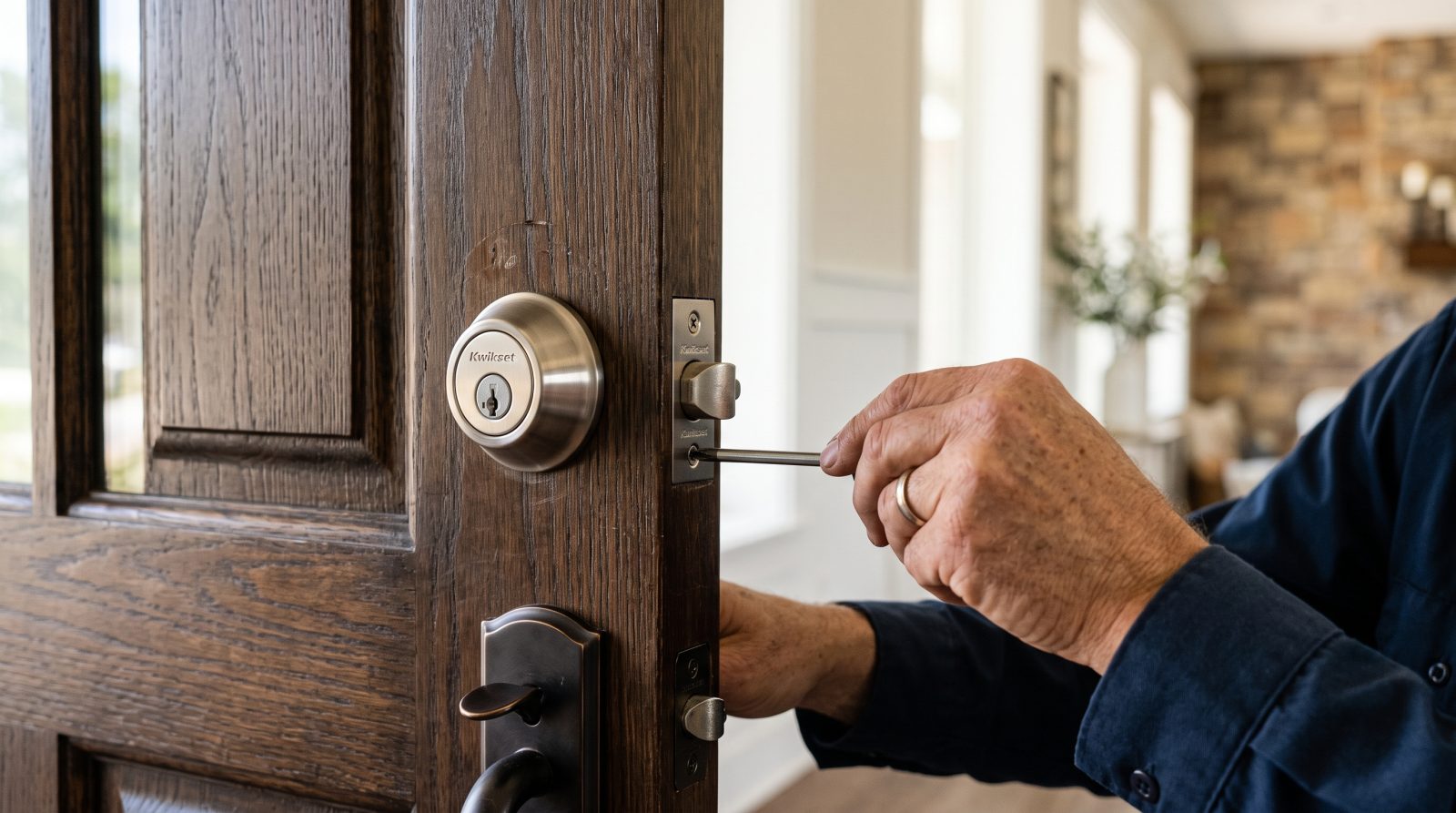
What does deadbolt installation actually involve?
A deadbolt is fundamentally different from the spring-latch lock built into most doorknobs. A knob latch is angled and spring-loaded, which is what lets the door click shut on its own, but it also means it can be pushed back fairly easily. A deadbolt throws a straight, solid bolt, usually around one inch long, that only moves when you turn the key or thumbturn. There is no spring to defeat, so the door cannot be forced open the same way.
Installing a deadbolt on a door that does not already have one means boring two precise holes: a large cross-bore through the face of the door for the lock body, and an edge-bore through the door edge for the bolt mechanism. A matching mortise (recess) is cut into the door jamb, and a metal strike plate is fastened there to receive the bolt. On a door that already has a deadbolt, replacement is usually faster because the holes already exist and the new hardware drops into the same prep.
The detail that often gets overlooked is the strike plate and the screws that hold it. A bolt is only as strong as the wood it lands in. We typically secure the strike plate with longer screws that reach past the thin door jamb and bite into the wall framing behind it, so the bolt is anchored to the structure rather than to a strip of trim. This single step makes a meaningful difference in how a door resists a kick.
Single-cylinder, double-cylinder, and smart deadbolts: which is right?
The right deadbolt depends on your door, who uses it, and any glass nearby. Below is a plain-language comparison of the common options so you can have an informed conversation before anything is installed.
- Single-cylinder deadbolt: keyed on the outside, with a thumbturn on the inside. This is the most common residential choice because the inside opens fast by hand, which matters in an emergency. Best suited to solid doors with no nearby glass.
- Double-cylinder deadbolt: keyed on both sides, so it requires a key to open from the inside too. Sometimes chosen for doors with glass panels or sidelights, because it stops someone from breaking the glass and simply reaching the thumbturn. The tradeoff is slower exit in an emergency, and many local building and fire codes restrict their use on required exit doors, so we will talk through whether it is appropriate and compliant for your situation.
- Smart deadbolt: a motorized deadbolt you operate with a keypad code, phone app, or both, often still with a physical key override. Good for households that want keyless entry, temporary codes for guests or service providers, and an activity log. We can install models that follow common standards like Z-Wave, Zigbee, Matter, or Wi-Fi so the lock works with the smart-home platform you already use.
- Keyed-alike option: if you are installing or replacing several deadbolts, they can often be configured so one key works all of them, which is convenient without sacrificing the lock quality.
Understanding deadbolt grades and security ratings
Deadbolts are rated by ANSI/BHMA (the American National Standards Institute and the Builders Hardware Manufacturers Association) into Grade 1, Grade 2, and Grade 3. The grade reflects how the lock performed in standardized tests for things like the number of operating cycles it survives and how much force it withstands.
Grade 1 is the highest residential and light-commercial standard and is built for the most demanding use and forced-entry resistance. Grade 2 is a solid step up from builder-basic hardware and is a common, sensible choice for many homes. Grade 3 meets the minimum residential standard. When we recommend hardware, we will explain the grade in concrete terms so the choice fits how exposed the door is and how much traffic it sees, rather than just selling the most expensive option.
Bolt throw and material matter too. A deadbolt with a full one-inch bolt throw seats deeper into the frame than a shorter throw. Hardened steel inserts inside the bolt help resist sawing, and a reinforced strike or a strike box can spread force across more of the frame. These are the kinds of upgrade details we factor in for an exterior or back door.
Security upgrades that pair well with a new deadbolt
A deadbolt is the centerpiece, but a door is a system. Several affordable upgrades multiply the benefit of a quality lock, and they are easy to add at the same visit while the door is already being worked on.
- Reinforced strike plate or strike box: a heavier-gauge plate with longer screws that anchor into the framing, so the bolt has something solid to hold onto.
- Door reinforcement plate (wrap): a metal plate that wraps the edge of the door around the lock area, helping a wooden door resist splitting at the bolt.
- Hinge reinforcement and longer hinge screws: the hinge side is a common weak point; longer screws and reinforcement make a door harder to pry from that edge.
- Rekeying existing locks to match: if you have just moved in or changed who has access, rekeying the new and existing locks so old keys no longer work is often smarter than wondering who still has a copy. Rekeying changes the internal pins so previous keys stop working, without replacing the whole lock.
- Sliding-door and secondary-entry hardware: patio sliders and side doors deserve attention too, since a strong front-door deadbolt does little if a softer entry is left as-is.
What to expect when you book Locksmith San Jose
We are a mobile locksmith, so we come to your home or business in San Jose and the surrounding South Bay rather than asking you to remove a door and bring it in. A typical visit starts with looking at the door itself, its thickness, the existing prep (the backset and bore size), the condition of the frame, and what you are trying to protect against. That assessment is what lets us recommend hardware that will actually fit and perform, instead of guessing in advance.
Once you approve the plan, installation of a standard residential deadbolt on a pre-bored door is usually quick. A door that needs fresh boring, or a frame that needs repair before a lock can hold, takes longer, and we will tell you that up front rather than after we have started. When the work is done, we test the lock through its full cycle, confirm the bolt seats cleanly without forcing the door, and hand over every key or code.
On pricing, we provide an estimate before any work begins. As a general guide, deadbolt installation costs in the industry commonly fall within a few tens of dollars to a few hundred dollars per lock, depending on the hardware grade, whether new boring is required, and any reinforcement add-ons. Those figures are typical industry ranges to help you plan, not a quote. The only way to get an accurate number for your door is a quick assessment, which is exactly what the free quote covers.