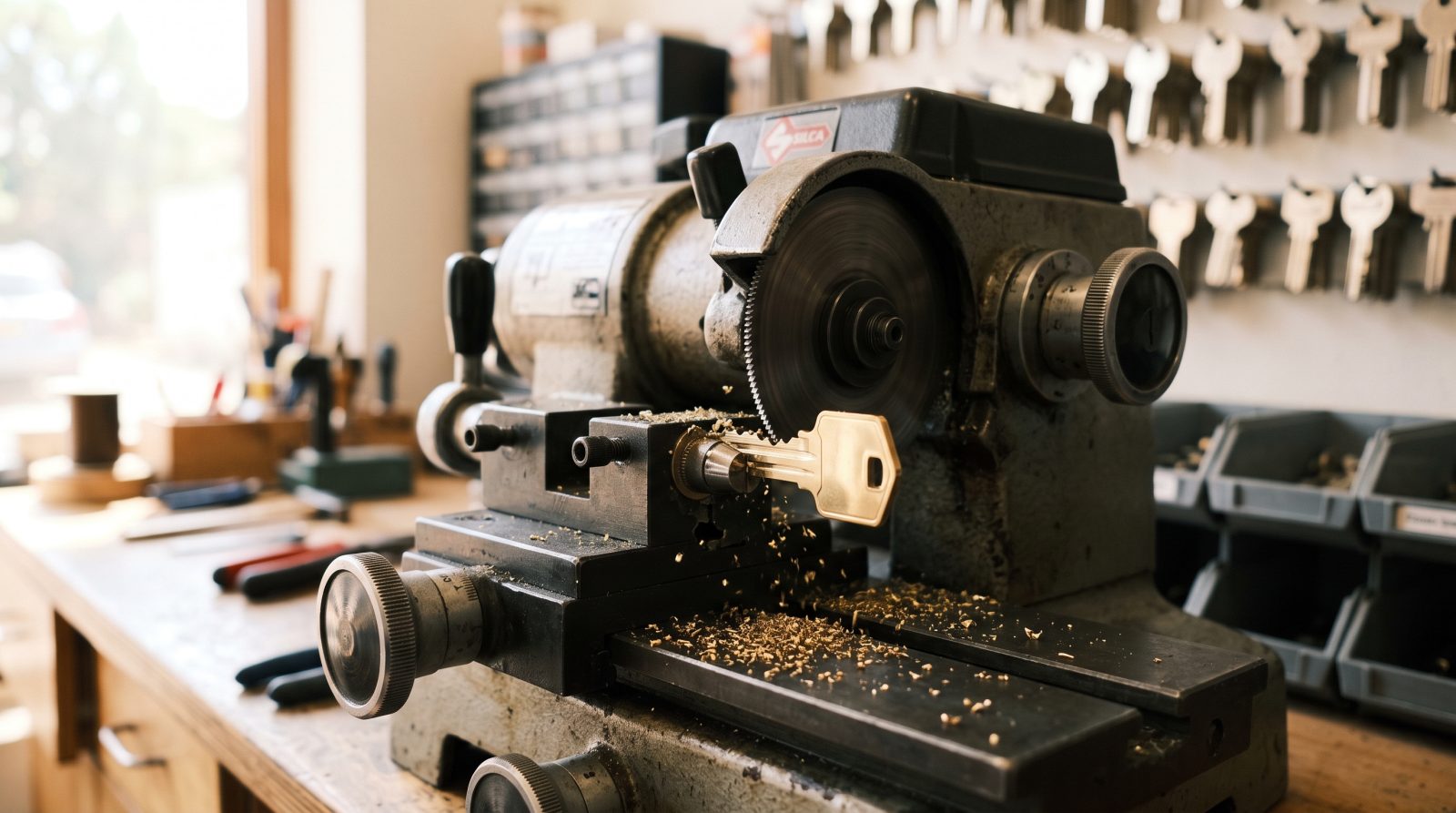
What is key duplication and how does it work?
Key duplication means producing a new key that matches the exact cuts of an existing one so both operate the same lock. For a standard mechanical key, the cuts (the jagged ridges along the blade) form a pattern of depths and spacings. A locksmith reads that pattern and reproduces it on a fresh blank that matches the original key's profile (its cross-section shape and groove pattern, which determine whether it physically fits the keyway).
There are two common methods. Tracing duplication uses a machine with a guide that follows the original key while a cutter mirrors each cut onto the blank. Code cutting skips the original and cuts a key from its recorded bitting code, which is useful when the original is worn or unavailable. Worn originals are the most common reason a copy turns out 'a little off,' because each cut is slightly shallow and the machine faithfully copies that wear.
Not every key is purely mechanical. Many newer car keys and some high-security home keys contain electronics or use restricted blanks, which changes the process and the price. Those are covered in the sections below so you know what to expect before you ask for a copy.
- Cuts: the depth-and-spacing pattern that lets a key turn a specific lock
- Blank: an uncut key chosen to match your key's profile and keyway
- Tracing: copy made by following the original on a duplicating machine
- Code cutting: copy cut from a recorded bitting code instead of the original
Which keys can we copy?
We duplicate a wide range of everyday keys for homes, rentals, and small businesses across San Jose. The most common are standard residential keys for deadbolts and knob locks, along with padlock keys, file cabinet keys, and mailbox keys. For multi-unit buildings and offices, we can copy individual unit keys when you are authorized to have them duplicated.
Some keys are intentionally harder to copy, and that is by design. High-security and patented keys (the kind that say 'Do Not Duplicate' or come from a restricted keyway system) often require proof of authorization and a manufacturer-supplied blank, so an ordinary hardware-store machine cannot copy them. That restriction is a security feature, not an obstacle to work around, and we follow it.
Vehicle keys are their own category. A simple older car key with no chip can be copied like a house key, but most modern car keys include a transponder chip and sometimes a remote, which must be cut and then electronically programmed to the vehicle. We handle many of these, and the timing and cost depend on the make, model, and year.
- House keys for deadbolts and knob/lever locks
- Padlock, mailbox, cabinet, and common office keys
- Many car keys, including transponder keys that need programming
- Restricted/high-security keys only with proof of authorization and the correct blank
What does key duplication cost in San Jose?
Pricing depends almost entirely on the type of key, not the brand of lock on your door. A basic house or padlock key is inexpensive because the blank is cheap and the cut takes seconds. The price climbs as keys add features: a high-security blank costs more, and an electronic car key adds the cost of the blank plus programming time and equipment.
The ranges below are typical industry estimates to set expectations, not quotes. Because we are a mobile service, a copy made at your home or office may also include a trip or service fee that a walk-in counter would not have. We will give you a clear price for your specific key before any cutting begins.
- Standard house/padlock key: roughly $2 to $10 per copy (typical estimate)
- High-security or restricted key copy: often $15 to $50+ depending on system (typical estimate)
- Non-chip (mechanical) car key copy: roughly $10 to $25 (typical estimate)
- Transponder/remote car key cut and programmed: commonly $100 to $300+ by make/model (typical estimate)
- Mobile trip/service fee may apply for on-site copying
Should you copy a key or rekey the lock?
Duplication and rekeying solve different problems, and choosing correctly saves money. Make copies when the people who should have access already have it and you simply need more working keys, for example a spare for a partner, a key for a house-sitter, or backups for staff who already hold one.
Rekey the lock instead when you want to control who can open the door going forward. Rekeying changes the lock's internal pins so old keys stop working, which is the right call after a move-in, a lost key, a tenant turnover, or a relationship change. In those situations, making more copies of the existing key only multiplies the access you are trying to reset.
A useful rule of thumb: duplication adds keys to the same circle of trust, while rekeying redraws the circle. If you are unsure which you need, describe the situation when you request a quote and we will point you to the option that actually fits.
- Copy a key: you trust everyone who will hold one and just need spares
- Rekey: you want previous keys to stop working (moved in, lost key, turnover)
- Copying after a lost key does not improve security; rekeying does
How to get clean, reliable copies
The single biggest factor in copy quality is the source key. Always duplicate from a sharp, lightly used original rather than from a copy of a copy, because small inaccuracies compound with each generation until the newest key drags or sticks. If your daily key is visibly worn, it is often better to cut a fresh key from a good original or from the lock's code, then copy that.
It also helps to bring the right reference. If you have several similar-looking keys, knowing which lock each one opens prevents a wasted copy. For mailbox, gate, or building keys, check whether your property has a 'Do Not Duplicate' policy first, since we honor those restrictions and may need authorization.
When you book mobile service, having the original key on hand and knowing how many copies you need lets us finish in one visit. For car keys, the vehicle and any existing working key should be present, because most modern keys must be programmed to the car itself.
- Duplicate from the best original you have, not from a worn copy
- Label or identify which lock each key opens to avoid wasted cuts
- Confirm any 'Do Not Duplicate' or restricted-key authorization in advance
- For car keys, have the vehicle and a working key available for programming
Mobile key copying across San Jose and the South Bay
As a mobile locksmith, we bring key duplication to you instead of asking you to find a counter that stocks the right blank. We serve San Jose and surrounding South Bay communities, including neighborhoods like Willow Glen, Almaden Valley, Cambrian Park, Berryessa, and Evergreen, as well as homes and small offices near the downtown core and the airport.
On-site copying is convenient for landlords handing keys to new tenants, property managers stocking spares, small businesses issuing keys to staff, and homeowners who simply do not want to make a trip. We carry common blanks and cutting equipment, and for less common keys we will tell you upfront whether we can cut it on the spot or need to source the right blank first.
Call us at (408) 614-7111, or send a free-quote request on this page. Tell us the key type, how many copies you need, and your area, and we will confirm availability and a clear price for your specific key.