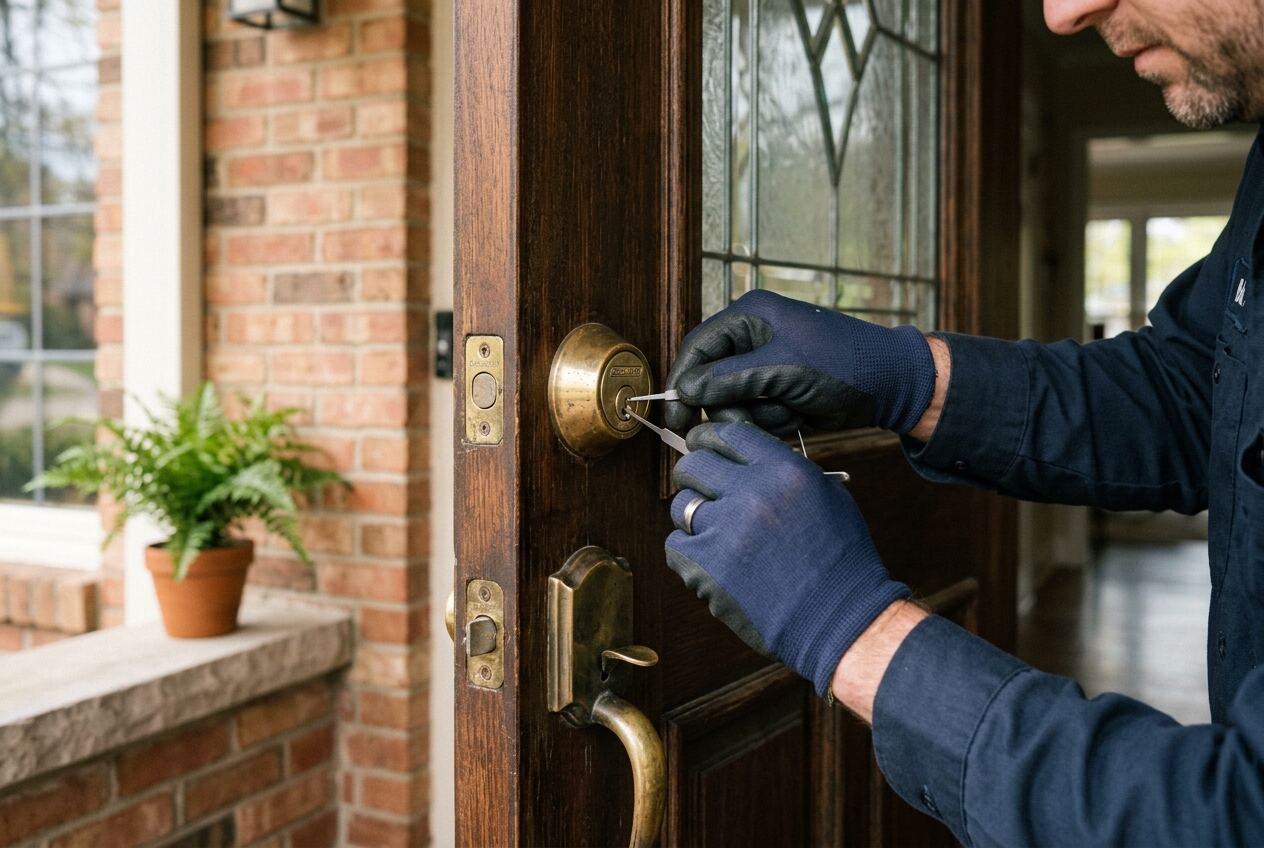
What is lock rekeying, and how does it work?
Rekeying is the process of resetting a lock to accept a different key. A standard pin-tumbler lock, the kind on most San Jose homes, uses a stack of small spring-loaded pins inside the cylinder. When the correct key is inserted, the cuts on the key push those pins to an exact height so the cylinder can turn. Rekeying swaps the bottom pins for a new set sized to a new key, so the old key no longer aligns the pins and stops working.
A locksmith removes the lock cylinder (or services it in place on some models), disassembles the plug, replaces the pin stack to match a freshly cut key, and reassembles it. The lock body, latch, strike, screws, and finish all stay exactly as they were; only the small internal pins and your key change. Because the work is mechanical and self-contained, a technician can usually rekey several locks in one visit.
Rekeying does not require any internet connection, app, or power, and it works on most residential deadbolts, knob and lever locksets, and many commercial cylinders. It does not change the security grade of the lock itself; a worn or low-grade lock that gets rekeyed is still the same lock, just keyed to a different key.
When should you rekey instead of replacing the lock?
Rekeying makes the most sense when the lock hardware is in good working order but you want to be sure old keys no longer open the door. Common situations include moving into a previously owned or rented home where you don't know how many copies exist, losing a key, ending a roommate or relationship, recovering a misplaced spare, or turning over a rental between tenants.
Replacement is the better choice when the lock is physically damaged, sticking, badly worn, or outdated, or when you want to upgrade to higher-grade or smart hardware. If a door has no deadbolt at all, you're adding hardware rather than rekeying. A locksmith can inspect the door and tell you which option fits; there's no benefit to rekeying a lock that's already failing.
- Rekey: you just moved in and want old keys retired
- Rekey: a key was lost or a spare went missing
- Rekey: a roommate, ex-partner, or former employee had a key
- Replace: the lock is damaged, jammed, or worn out
- Replace or upgrade: you want a higher-security or smart lock
- Key-alike: rekey several locks so one key opens them all
What does lock rekeying cost in San Jose?
Rekeying is priced two ways: a service call or trip charge to come to your location, plus a per-cylinder (per-lock) rekey fee. The figures below are typical ranges for the San Jose and South Bay area and are provided as estimates to help you plan; they are not a quote. Your actual price depends on the number of locks, the lock type, whether the hardware is standard or high-security, and the time of day.
Because the trip charge is usually a fixed cost, rekeying several locks in one visit lowers the average cost per lock. If you'd like firm numbers for your specific doors, request a free quote and we'll give you a clear figure before any work begins.
- Service or trip charge: roughly $35 to $100 (typical estimate)
- Standard residential rekey: roughly $15 to $30 per cylinder (typical estimate)
- Most homes have 2 to 4 exterior locks to rekey
- High-security or restricted-keyway cylinders cost more and may need specific key blanks
- Keying multiple locks alike (one key for all) may add a small per-lock charge
- Estimates only; get a free quote for an exact price
Rekeying for homes, rentals, and businesses
For homeowners, rekeying is a simple peace-of-mind step after closing on a house or finishing a remodel where contractors held keys. You can also have multiple doors keyed alike so a single key opens the front door, back door, and garage entry, which is convenient without losing the ability to retire that key later.
For landlords and property managers across San Jose, rekeying between tenants is a standard turnover task: it helps ensure a departing tenant's keys won't open the unit for the next resident, while keeping the existing hardware and avoiding the cost of new locks each cycle. Keeping a simple record of which units were rekeyed and when helps with documentation.
For businesses, rekeying handles staff changes, lost master keys, and access control on a budget. Many commercial settings use master-key systems, where individual keys open specific doors and a master key opens all of them; a locksmith can rekey within that system so a lost key can be retired without rekeying the entire building. We won't publish details about defeating or bypassing locks; the goal is always to strengthen your control over who can get in.
What to expect from a San Jose rekey visit
A rekey appointment is straightforward. The technician confirms which locks you want rekeyed, verifies the hardware is suitable, and cuts a new key for the door. Each cylinder is opened, re-pinned to the new key, reassembled, and tested with the new key to confirm smooth operation, then tested to confirm the old key no longer works.
You'll typically receive the new working keys (and can request extra copies), and the old keys become inert for that lock. Most standard residential locks take only a few minutes each, so a typical multi-door home is often done in a single short visit. Since we serve the South Bay as a mobile locksmith, the work is done at your door rather than requiring you to remove and transport hardware.
You can reach us at (408) 614-7111, or request a free quote on this page. Tell us your neighborhood, how many doors you need rekeyed, and the lock types if you know them, and we'll follow up to schedule.