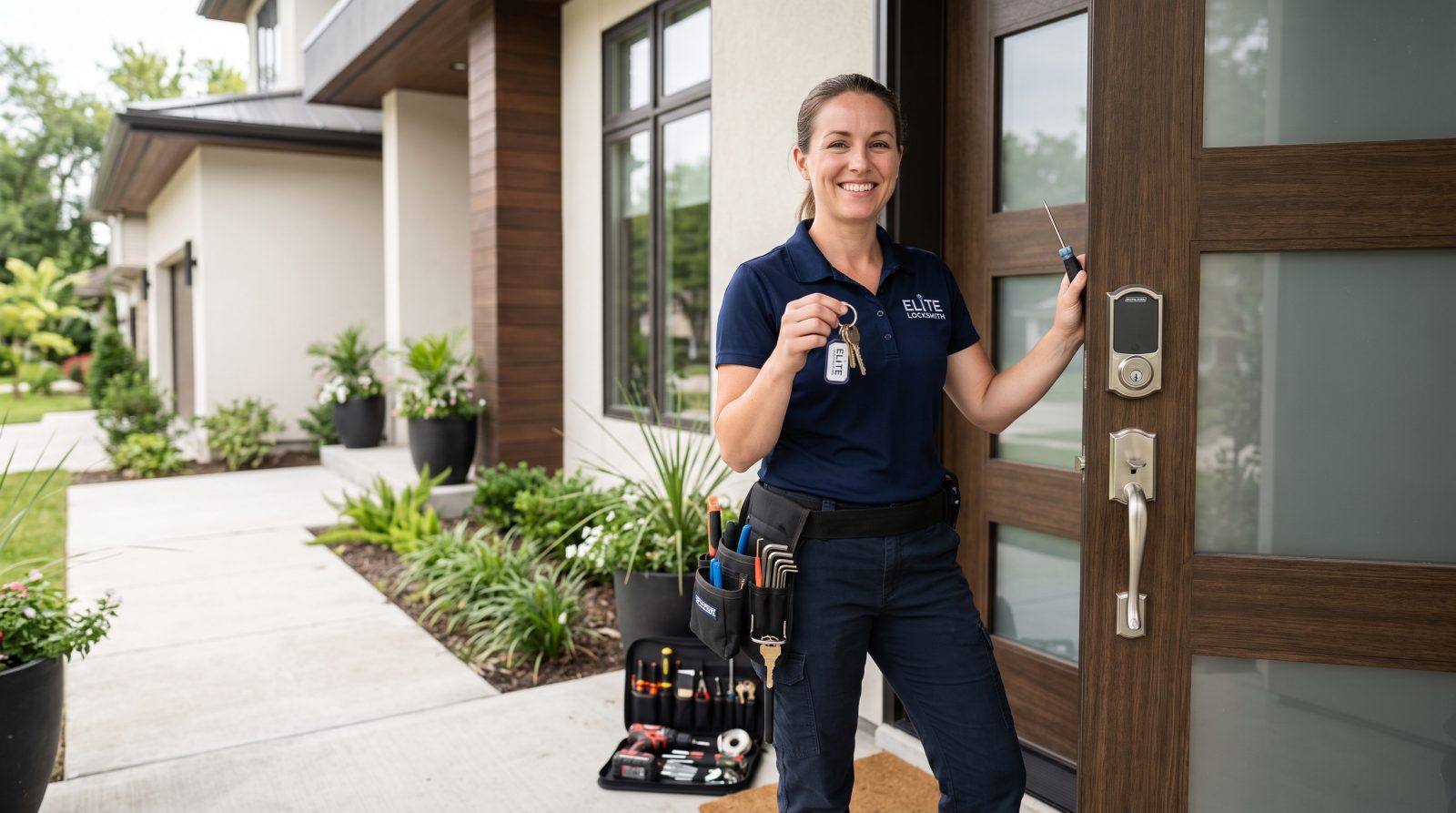
How door locks are grouped (and why it matters)
Before the individual lock types make sense, it helps to know the two big families they fall into. Most residential door locks are either a latch lock, which uses a spring-loaded angled bolt that snaps shut on its own when the door closes, or a deadbolt, which uses a solid rectangular bolt you throw manually by turning a key or thumbturn. Latches are about convenience and keeping a door from drifting open; deadbolts are about security. A standard exterior door in San Jose typically has both: a knob or lever with a spring latch for everyday use, plus a separate deadbolt above it for added protection.
Locks are also described by how the working parts sit in the door. A bored cylindrical lock fits into round holes drilled through the door face and edge, which is why most off-the-shelf knobs and deadbolts install quickly. A mortise lock sits inside a deep rectangular pocket cut into the edge of the door and houses multiple functions in one body. Rim locks mount on the surface of the door's interior face. Knowing which style your door is built for prevents buying hardware that won't fit, a common mistake on older Willow Glen and Naglee Park homes with non-standard doors.
Finally, locks differ by how they grade for durability and force resistance. Independent testing assigns residential and commercial grades, with the strongest grade rated for the heaviest use and highest resistance to physical attack. You don't need commercial-grade hardware on an interior closet, but a front entry door benefits from a higher-grade deadbolt. When we talk through options on a service call, we try to match the grade and lock type to how the door is actually used rather than pushing hardware you don't need.
Deadbolts: the workhorse of exterior doors
A deadbolt is the lock most people picture when they think about door security. Turning the key or thumbturn drives a solid metal bolt straight out of the door edge and into a strike plate fixed to the frame. Because there is no spring, the bolt can't be pushed back the way a latch can be, and a quality deadbolt with a bolt that throws at least an inch into the frame is one of the most effective hardware upgrades for most homes.
Deadbolts come in a few configurations. A single-cylinder deadbolt takes a key on the outside and has a thumbturn on the inside, which is the most common residential setup. A double-cylinder deadbolt needs a key on both sides, sometimes used on doors with glass nearby so a broken pane can't be reached through to flip a thumbturn; the tradeoff is that it can slow an exit in an emergency, so it's a decision to make carefully and in line with local fire-safety guidance. There are also keyless thumbturn-only deadbolts for interior or secondary doors.
- Single-cylinder: key outside, thumbturn inside; the standard front-door choice
- Double-cylinder: keyed both sides; weigh the emergency-egress tradeoff
- A strong strike plate with long screws into the framing matters as much as the lock itself
- Best paired with a knob or lever for everyday latching
Knob, lever, and mortise locks: everyday entry hardware
Knob locks (also called cylindrical locks) are the round-handle locks you see on countless doors. The locking mechanism lives in the knob itself, which is convenient and inexpensive but also their weakness on an exterior door, since the knob can be attacked directly. For that reason knob locks are best used on interior doors or alongside a deadbolt, rather than as the only lock on an entry door.
Lever-handle locks work on the same cylindrical principle but use a push-down handle instead of a round knob. They are easier to operate for anyone carrying groceries or with limited hand strength, which makes them a popular accessibility-friendly choice for both homes and offices around San Jose. Like knob locks, they're convenience hardware and pair well with a separate deadbolt.
Mortise locks are a heavier, older design common in mid-century and historic San Jose homes, including many in the Hanchett Park and Rose Garden areas. The lock body slots into a rectangular pocket cut into the door edge and can combine a latch and a deadbolt in one robust unit. They are durable and substantial but more involved to service or replace, so matching the exact body size and function set is important when a mortise lock needs repair or upgrading.
- Knob locks: low cost, convenient, but exterior use only with a deadbolt
- Lever locks: easier to operate, good for accessibility, common in offices
- Mortise locks: strong all-in-one bodies, often found in older homes, more specialized to service
Smart and electronic locks: keypads, fobs, and apps
Smart locks replace or supplement a key with a keypad code, a phone app, a fob, or a fingerprint reader. Most consumer smart locks are essentially a motorized deadbolt: the security still comes from a real bolt thrown into the frame, while the electronics control when it locks and unlocks. That means the mechanical fundamentals that matter for any deadbolt, a deep bolt throw and a solidly mounted strike, still apply to a smart lock.
The category covers a wide range. Keypad deadbolts let you share a numeric code instead of cutting keys, which is handy for letting in a house cleaner or a contractor. App-connected models add remote lock/unlock and activity logs over your home Wi-Fi or a hub. Many smart locks support common interoperability standards so they can talk to mainstream home-automation systems, and most keep a physical key override or a backup power option in case batteries die. Because these locks depend on batteries and software, plan for periodic battery changes and firmware updates, and choose models with a sensible offline fallback.
For San Jose households juggling deliveries, dog walkers, and family schedules, the appeal is control and visibility rather than raw strength. We can advise on choosing a smart lock that fits your existing door prep, retains a mechanical backup, and is installed so the bolt seats correctly, which is where many do-it-yourself smart-lock installs go wrong.
- Keypad deadbolts: share a code instead of a key, no app required
- App/Wi-Fi locks: remote control and access logs, dependent on power and network
- Look for a physical-key or backup-power override before you buy
- Security still comes from the bolt and strike, not the electronics
Specialty locks: rim locks, padlocks, and add-on security
Beyond the main entry hardware, a few specialty locks solve specific problems. Jimmy-proof rim locks mount on the inside surface of the door and interlock with a surface-mounted strike, making the door harder to pry apart at the jamb; they're often added to apartment and older multi-unit doors as a secondary lock. Surface deadbolts and slide bolts serve a similar add-a-lock role for garage entry doors, sheds, and gates.
Padlocks are the portable, removable option for gates, storage units, tool sheds, and side yards. They range from lightweight luggage-style locks to hardened-shackle models meant to resist cutting, and the right choice depends on what you're securing and how exposed it is. Outdoor padlocks in the Bay Area also benefit from weather- and corrosion-resistant construction given our damp winters.
There are also smaller pieces of door hardware that quietly improve security: longer strike-plate screws that bite into the wall framing, reinforced strike boxes, and door-edge wrap plates. These aren't locks themselves, but they often do more to keep a door closed under force than swapping the lock alone. When we assess a door, we look at the whole assembly, the lock, the strike, the frame, and the door itself, because a strong lock in a weak frame is only as good as what holds it.
- Rim / jimmy-proof locks: surface-mounted secondary locks that resist prying
- Padlocks: portable security for gates, sheds, and storage; match shackle strength to the risk
- Strike reinforcement and longer screws upgrade security without a new lock
Rekey vs. replace, and how to choose for your San Jose home
Choosing a lock isn't only about the type, it's also about whether you need new hardware at all. Rekeying changes the internal pins of an existing lock so old keys no longer work and a new key does, all without removing the lock from the door. It's the cost-effective choice when the hardware is in good shape but you've moved into a new place, lost a key, or had a roommate or contractor move out. Replacing the lock makes sense when the hardware is worn, damaged, outdated, or when you want a different type, such as upgrading a knob-only entry to a graded deadbolt or moving to a keypad lock.
For most San Jose homes, a practical baseline is a quality single-cylinder deadbolt on each exterior door, paired with a lever or knob for everyday latching, and a reinforced strike plate anchored into the framing. From there, smart locks add convenience for busy households, and specialty hardware fills gaps on garages, gates, and side doors. The right mix depends on your doors, your routine, and your budget, not on a one-size-fits-all package.
As a local mobile locksmith serving San Jose and the South Bay, Locksmith San Jose can assess your existing doors, explain the options in plain terms, and recommend rekeying or replacement based on what you actually have. If you're weighing lock types or planning an upgrade, request a free quote and we'll help you choose hardware that fits your door and your needs. (Built by Digital Optima.)
- Rekey: keep the lock, change which key works; lowest-cost security reset
- Replace: when hardware is worn, dated, or you want a different lock type
- A typical baseline: graded deadbolt + lever/knob + reinforced strike on each entry