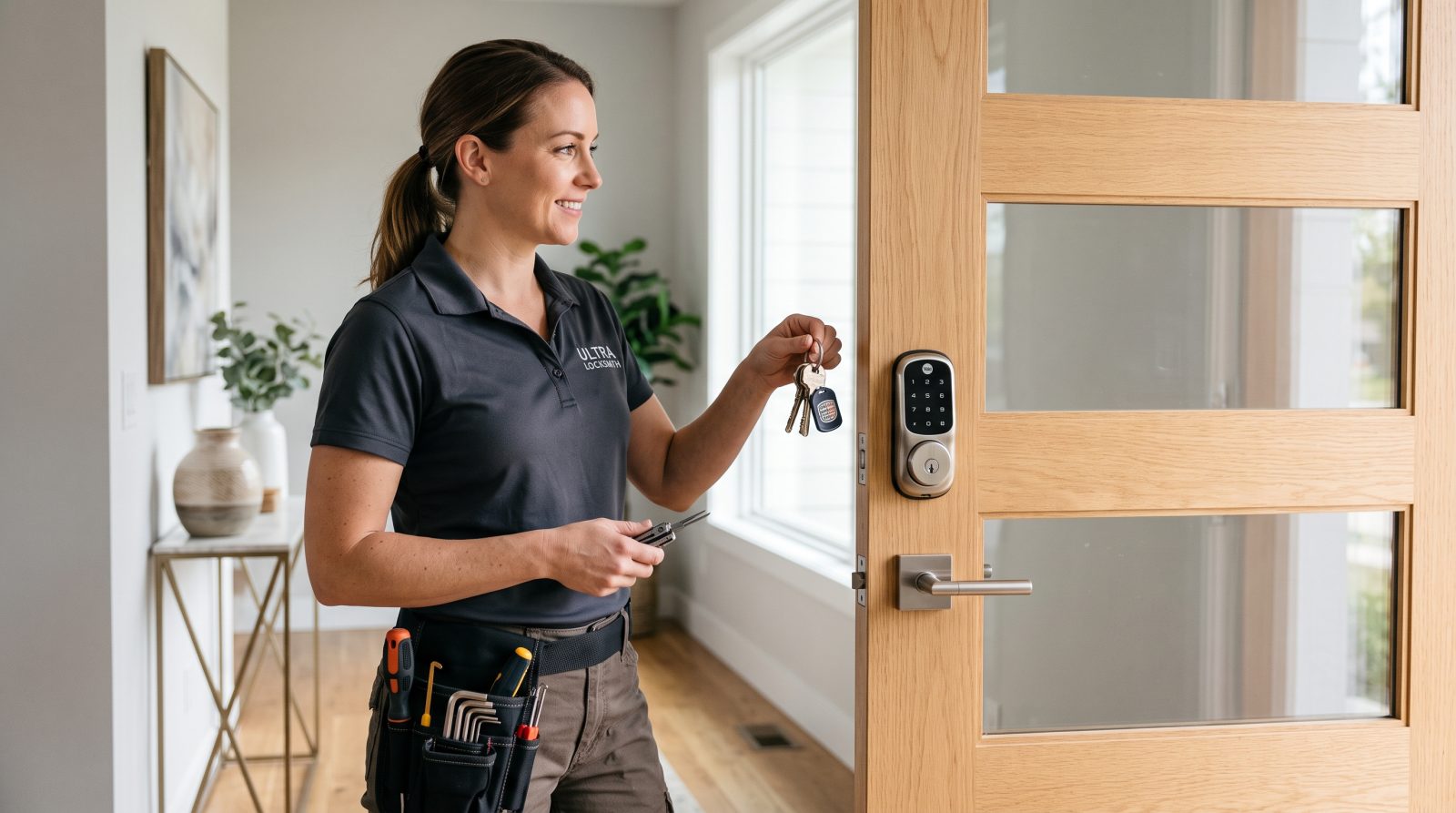
What does it actually mean to rekey a lock?
Rekeying means keeping the lock body you already own and resetting it so a different key is required to operate it. Nothing on the outside changes: the same deadbolt, knob, or lever stays mounted on your door, the same strike plate and screws stay in place, and the door itself is untouched. What changes is the internal code hidden inside the cylinder, so every key cut to the old code stops working once the job is done.
It helps to separate two ideas that people often blur together. Replacing a lock means taking off the old hardware and installing a brand-new unit, which makes sense when a lock is worn, damaged, outdated, or you want a different style or security grade. Rekeying leaves the hardware alone and only alters who has a working key. If your locks are in good shape and your real goal is to stop old keys from working, rekeying is often the more direct and economical path.
Rekeying is also not the same as changing your key. You are not just cutting a copy of what you already have; you are deliberately making your current keys obsolete and starting fresh with a new key that only you control.
How a pin-tumbler lock works (the part that gets changed)
To understand rekeying, it helps to picture what is inside a standard residential lock. Most house deadbolts and knobs use a pin-tumbler cylinder. Inside that cylinder is a rotating plug, and drilled across the plug and the housing above it are a series of small chambers, usually five or six. Each chamber holds a tiny spring, a top pin (the driver pin), and a bottom pin (the key pin) that rests on the key when it is inserted.
When no key is in the lock, the springs push the pins down so they straddle the gap between the plug and the housing. That overlap physically blocks the plug from turning. When you insert the correct key, the cuts and grooves along its edge lift each pin stack to a precise height so that every gap between the top and bottom pins lines up at the shear line, the seam between the plug and the housing. Once all the pin stacks are aligned at that line, the plug is free to rotate and the bolt moves.
A wrong key fails because its cuts lift the pins to the wrong heights, leaving at least one pin crossing the shear line and stopping the plug. Rekeying works by swapping the bottom key pins for a new set of heights, which means a brand-new key shape is required to reach the shear line, and the old key no longer fits the new arrangement.
- Plug: the part that rotates when the correct key is inserted
- Shear line: the seam the pins must clear for the plug to turn
- Key pins (bottom pins): rest on the key and are the pins swapped during rekeying
- Driver pins (top pins) and springs: push down to keep the lock secured until the right key lifts the stacks
The rekeying process, step by step
A typical rekey on a standard pin-tumbler lock follows a consistent sequence. While the exact tools vary by lock brand, the logic is the same across most residential hardware, and a single lock is usually a quick job once the cylinder is accessed.
Throughout the process, a careful locksmith keeps track of the original keying so you are not left without access, tests the lock several times before reinstalling it, and hands you the new keys along with a clear count of how many were cut. When the work is done correctly, nothing about the procedure damages the door or the lock body.
- Remove the lock or cylinder from the door so the inner mechanism can be reached.
- Take out the plug, controlling the small springs and driver pins so they do not scatter.
- Remove the old bottom key pins, which were sized for your old key.
- Insert the chosen new key and fit new bottom pins sized to its cuts so each stack aligns at the shear line.
- Reassemble the plug, springs, and driver pins, then reinstall the cylinder in the lock and the lock on the door.
- Test the new key several times locked and unlocked, and confirm the old keys no longer work.
When rekeying is the right call (and when replacement makes more sense)
Rekeying shines whenever the lock hardware is fine but you want to change who holds a working key. Moving into a home you just bought or rented is the classic example, because you rarely know how many copies the previous owner, agents, contractors, or cleaners still have. The same logic applies after losing a key, after a roommate or tenant moves out, after a breakup or a contractor finishes a job, or any time you simply want a clean slate on access.
Rekeying is also a good fit when you want several different locks to open with one key. If your front door, back door, and side gate each came with their own key, a locksmith can often rekey them all to a single matching key, as long as the locks are the same brand and keyway. That convenience is a big reason people rekey rather than replace a working set of locks.
Replacement makes more sense in specific situations: the lock is worn out, sticky, rusted, or visibly damaged; the lock is an older or lower-grade unit you want to upgrade; the cylinder is incompatible with the key you want to standardize on; or you want a different style or a feature set like a keypad or smart lock that the current hardware cannot provide. A good locksmith will inspect what you have and tell you plainly which path fits your doors and budget rather than pushing the more expensive option.
- Lean toward rekeying: good-condition locks, recent move, lost key, tenant turnover, or you want one key for several doors
- Lean toward replacement: worn or damaged hardware, outdated or low-grade locks, mismatched keyways, or you want a new style or smart/keypad features
What about master keying and high-security locks?
Master keying is a more advanced form of rekeying often used in offices, rentals, and multi-unit buildings. By adding small spacer pins (called master wafers) to the pin stacks, a locksmith can set up a lock so that two different keys both work: an individual key for one specific door and a master key that opens many doors. Each pin stack ends up with more than one valid height, which is how a single master key can clear the shear line on a whole group of locks while each tenant or staff key only opens its own door.
Master-keyed systems trade a little raw security for added convenience and control, since adding master heights creates more key combinations that can turn the lock. For most homes that is not a concern, but it is worth understanding when you manage a property and want layered access. A locksmith can design a system that fits how your building is actually used.
High-security and restricted-keyway locks work on similar pin-tumbler principles but add features like patented key control, harder-to-pick mechanisms, and keys that cannot be duplicated at a hardware store. These can usually still be rekeyed, but the parts and keys are controlled, so the work typically routes through an authorized dealer for that brand. If you have high-security hardware, mention the brand when you ask for a quote so the right approach and parts can be confirmed up front.
What to expect when you book a rekey in the San Jose area
Locksmith San Jose is a local mobile locksmith serving San Jose and the South Bay, which means a rekey is typically handled on site at your home or business rather than requiring you to remove and ship a lock. When you reach out, it helps to describe what you have so we can come prepared: how many doors and locks, whether they are deadbolts, knobs, or levers, the lock brand if you know it, and whether you want all doors keyed alike to a single key.
Because we are upfront about scope and cost, you will get a clear price range before any work begins, presented as a typical estimate rather than a binding figure until we see the hardware. Rekeying is generally one of the more affordable locksmith services compared with full lock replacement or cutting and programming a car key, but the final figure depends on how many locks you have, their brand and condition, and whether any need replacement instead of rekeying. As with any locksmith work, a reputable provider will ask for identification showing you are authorized to access the property, which protects you as much as it protects us.
We will not invent reasons to replace a lock that can simply be rekeyed, and we will tell you directly if a lock is too worn or damaged to rekey safely. To get started, request a quote and tell us a little about your doors. One quick tip while you decide: rekeying matters most right after a move or a lost key, so it is worth handling before you settle in rather than putting it off.
Built by Digital Optima.