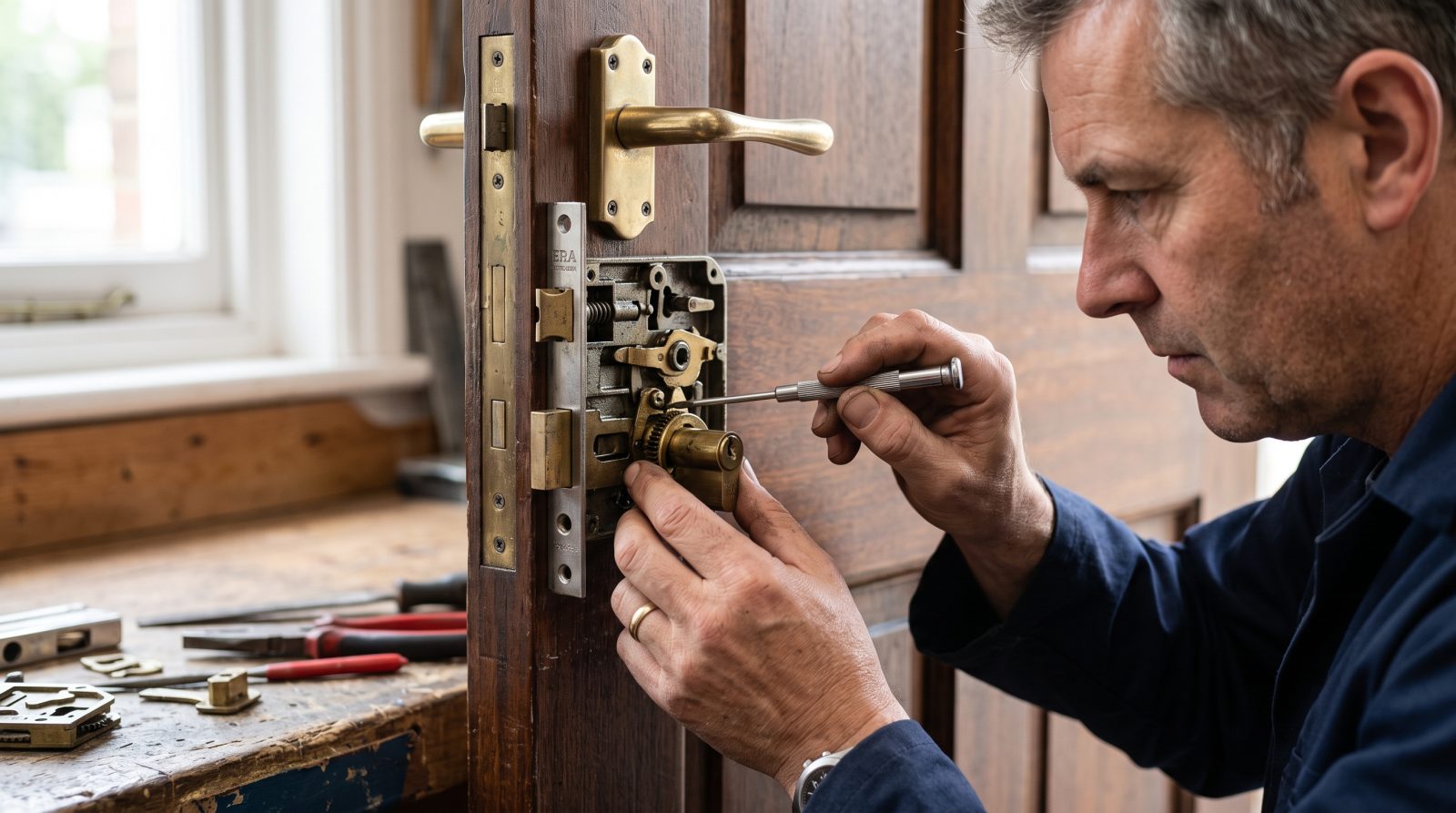
What does lock repair actually fix?
Lock repair covers the mechanical problems that build up over years of daily use. Most locks fail gradually rather than all at once, so the symptoms you notice — a key that catches, a deadbolt that won't fully throw, a knob that spins — are usually the visible end of wear that started long before. A locksmith's job is to trace the symptom back to the part that's worn, bent, dirty, or out of alignment and correct that specific issue.
Common repairs fall into a few categories. Cylinder problems happen when the internal pins and springs wear or collect grit, making a key hard to insert or turn. Latch and bolt problems occur when the moving bolt no longer lines up with the strike plate or door frame, often because the door or frame has shifted with weather and settling. Hardware problems include loose set screws, stripped knobs and levers, and worn handle mechanisms. Each has a different fix, and a careful diagnosis is what keeps you from paying to replace a lock that only needed an adjustment.
Repair is not always the right answer. If a lock is structurally damaged, badly corroded, or no longer holds securely, replacement is the honest recommendation, and we'll tell you when that's the case rather than patching something that won't last.
Why is my lock sticking or hard to turn?
A sticking lock usually means the key and the internal pins are no longer moving smoothly together. The most frequent causes are a worn key, a worn cylinder, debris or dust inside the keyway, dried-out lubrication, or a key that was cut slightly off from the original. Because a single worn key gets copied again and again, many people unknowingly use a copy of a copy that has drifted away from the lock's true cut, which makes every turn a small fight.
Before forcing a sticking lock, it's worth knowing what not to do. Wrenching a stubborn key is the fastest way to snap it off inside the cylinder, which turns a simple tune-up into an extraction job. Oily household lubricants can also gum up a pin-tumbler mechanism over time by attracting dust. A locksmith will typically clean the keyway, service the cylinder, check the key against the lock, and use a lubricant appropriate for lock hardware.
If the key turns but the bolt still drags, the issue is often outside the cylinder — the door has shifted and the bolt is rubbing the strike. That's an alignment fix, not a cylinder fix, which is why diagnosis matters.
Loose, spinning, or wobbly locks and handles
A knob or lever that wobbles, spins freely, or feels loose is one of the most common service calls, and it's frequently one of the simpler repairs. Door hardware is held together by screws and set screws that loosen with thousands of daily turns. When they back out, the handle develops play, the latch may not retract fully, and in the worst cases the assembly can pull apart.
The fix depends on the cause. Sometimes it's tightening or replacing the screws and set screws that hold the assembly to the door. Other times an internal spring or the spindle that connects the two handles has worn out, so the handle no longer springs back or no longer drives the latch. A loose deadbolt thumb-turn can mean the mounting screws are loose or the internal tailpiece is worn.
A loose lock isn't only an annoyance — it's a security gap. A handle that doesn't fully retract or extend the latch can leave a door that looks closed but isn't securely latched. We check that the latch and bolt seat fully into the strike before we consider the repair finished.
Repair, rekey, or replace: how to choose
These three options solve different problems, and confusing them is a common way to overspend. Repair restores the mechanism you already have. Rekeying changes which key operates the lock by re-arranging the internal pins — the lock stays, but old keys stop working. Replacement swaps in entirely new hardware.
Rekeying is the right call when the lock works fine mechanically but you've lost control of who has keys: after moving into a new home, losing a key, a roommate or tenant moving out, or finishing a renovation when contractors had access. It's typically cheaper than replacing locks because you keep the existing hardware. Repair is right when the lock sticks, binds, or feels loose but is otherwise sound. Replacement is right when the lock is damaged, corroded, obsolete, or you want a different type or higher security grade.
Mechanically, rekeying re-pins the cylinder so a new key works and old keys don't; it does not make the lock stronger, it changes who can open it. If your goal is better security rather than key control, that points toward repair plus an upgrade, or replacement with a higher-grade lock.
What a lock repair visit looks like
Because we're a mobile locksmith, the repair happens at your door anywhere across San Jose and the surrounding South Bay rather than at a shop. A typical visit starts with a few questions and a hands-on test so we can see the lock fail the way you described it. Watching the actual symptom — where the key catches, whether the bolt drags, whether the handle has play — is what separates a real diagnosis from a guess.
From there we identify the failing part and walk you through the options before doing the work, so you know what's being fixed and roughly what it involves. Many repairs are completed on the spot: cleaning and servicing a cylinder, adjusting a strike plate, tightening or replacing worn hardware, freeing a binding latch, or rekeying. If a part needs to be sourced or the right fix is replacement, we'll say so plainly.
Before we call it done, we cycle the lock with the door both open and closed, key in and key out, locked and unlocked, to confirm it operates smoothly and latches fully every time. A repair that works once but binds on the third try isn't finished.
What lock repair typically costs
Lock repair pricing depends on what's actually wrong, the type of lock, and how many doors are involved, so the figures below are typical industry ranges for planning, not quotes. A simple service or adjustment — cleaning a cylinder, tightening hardware, realigning a strike — generally falls at the lower end. Rekeying is usually priced per cylinder, with the first lock costing more than each additional matching lock done in the same visit. Repairs that require new internal parts, or replacing the lock outright, cost more depending on the hardware.
Several factors move the number: high-security or commercial-grade locks, smart locks with electronics, multiple doors, and after-hours or hard-to-reach situations all add to a job. The honest way to handle pricing is to diagnose first, then give you a clear price for the specific repair before any work begins.
For an accurate number on your exact situation, the best step is to request a free quote and tell us the lock type and what it's doing. We'd rather give you a real figure than a guess.