What does a Palo Alto locksmith actually do?
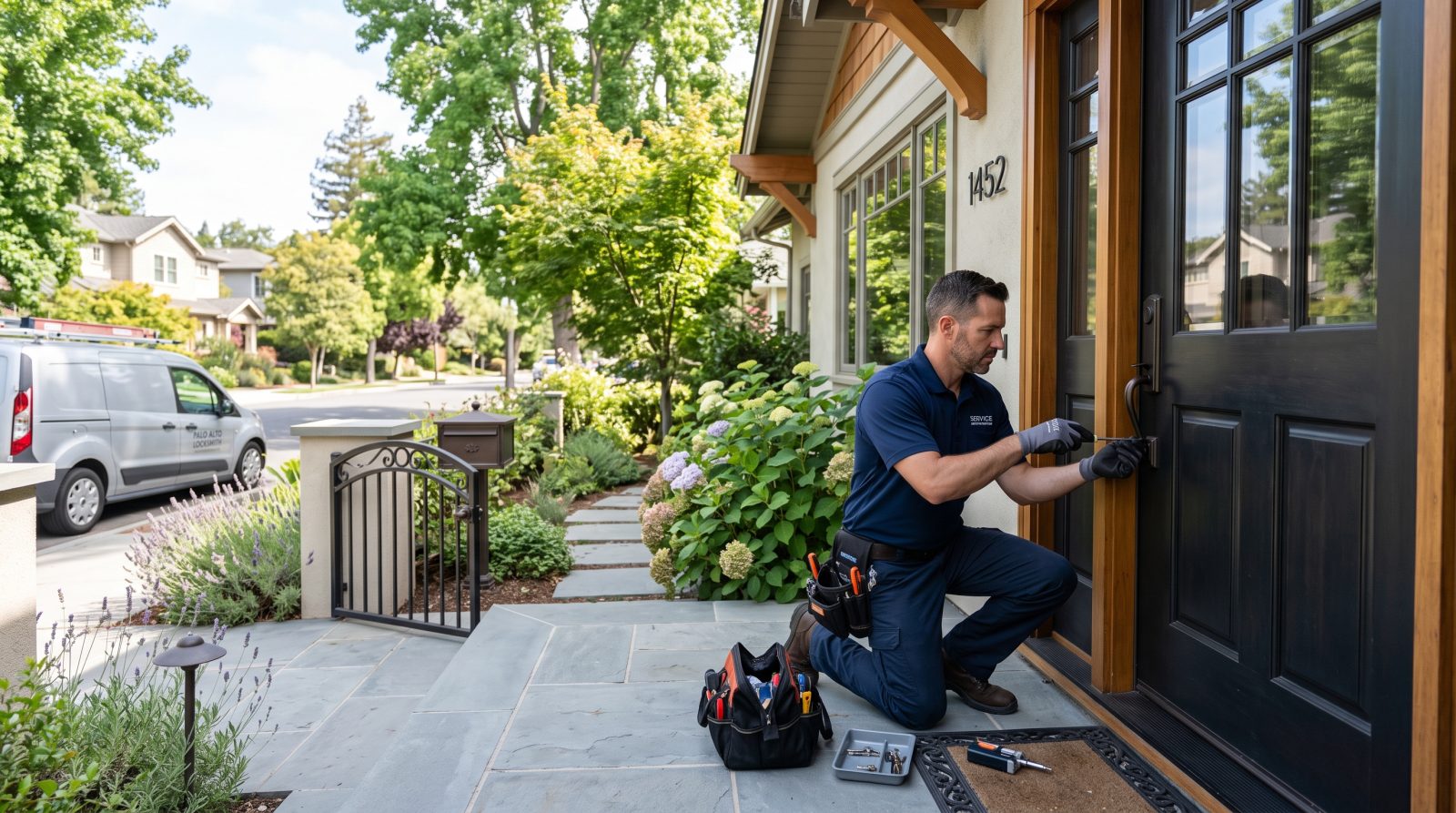
A locksmith does far more than open a door someone is locked out of. Day to day, the work falls into three buckets. Residential covers home lockouts, rekeying locks so old keys stop working, replacing worn or damaged deadbolts and knob locks, fixing doors that won't latch, and installing smart locks on entry doors. Commercial covers office lockouts, master-key systems, rekeying after staff turnover, and servicing storefront and glass-door hardware. Automotive covers vehicle lockouts and replacement or programming of car keys and fobs.
In a city like Palo Alto — a mix of older single-family homes near Professorville and Crescent Park, dense condos and apartments around downtown and California Avenue, and offices spread from the Stanford Research Park to the El Camino corridor — that range matters. The lock on a 1920s craftsman near Ramona Street is a different job from a modern multipoint lock on a newer townhome, and a tenant who just signed a lease near the Caltrain station usually wants a rekey, not a full replacement.
Knowing which service you need saves money. A lockout is a one-time visit; a rekey changes who can get in without replacing hardware; a replacement is for hardware that is broken, badly worn, or being upgraded. When you request a quote, describing the situation in plain words is enough — we translate it into the right service.
Which Palo Alto neighborhoods and areas do you serve?
We serve Palo Alto and its adjacent communities as a mobile service, traveling to your address rather than working from a counter. Coverage spans the whole city, north to south, and the immediate Peninsula neighbors it blends into.
Because the city is geographically spread out — roughly from the Baylands and the U.S. 101 frontage on the east to the foothills and Stanford lands on the west — sharing a cross street or a nearby landmark when you request a quote helps a technician route to you efficiently.
- Downtown / University Avenue and the Ramona Street historic district
- Professorville, Crescent Park, and Old Palo Alto near Embarcadero Road
- California Avenue business district and the Evergreen Park / Mayfield area
- Midtown along Middlefield Road and the Charleston–Meadow corridor
- Barron Park, Greenmeadow, and the South Palo Alto neighborhoods
- College Terrace and the Stanford Research Park office area
- Adjacent areas including Menlo Park, East Palo Alto, Los Altos, and Mountain View
Rekey vs. replace: which is right for your Palo Alto home?
This is the most common question we get from Palo Alto homeowners and renters, and the answer usually comes down to the condition of the hardware and who currently has keys. Rekeying changes the internal pins of an existing lock cylinder so the old keys no longer work and a new key does. The lock stays on the door; only the key that operates it changes. Replacement means removing the existing lock and installing new hardware entirely.
Rekeying is typically the right call after you buy a home, move into a rental, lose track of how many copies of a key are floating around, or part ways with a roommate, housekeeper, or contractor. It is usually faster and less expensive than replacing, and you keep the look of your existing doors — which matters in the older Palo Alto neighborhoods where original or matched hardware is part of the home's character.
Replacement makes sense when a lock is physically failing — sticking, grinding, loose, or not latching — when it predates current standards, or when you want to upgrade to a higher-security deadbolt or a smart lock. As a rough guide, if the hardware works smoothly and you only need to control who has a key, rekey; if the hardware itself is the problem or you want new features, replace. We will tell you honestly which one fits when we see the door.
What happens during a lockout call?
A lockout is stressful, so it helps to know what to expect. When you request help, we confirm the address, the type of property (house, condo, apartment, office, or vehicle), and which door or lock is involved. For security reasons, a locksmith should verify that you have the right to access the property before opening it — for a home that usually means showing ID with the address or other reasonable proof of residency or authorization once on site. This is standard and protects you as much as it protects the locksmith.
On arrival, the technician assesses the lock and chooses the least invasive method that works. The goal is to get you back inside while protecting the door and the lock. In many cases a residential or office lock can be opened without damage; if a lock is already broken or a key has snapped off inside, the visit may also involve extraction or, occasionally, replacing the cylinder. We will explain what we find and what it will take before doing the work.
For privacy and safety, we do not publish techniques for defeating locks. What we can tell you is the practical part: have a way to prove the property is yours, and if a key broke off in the lock, leave it in place rather than digging at it, since that can push the fragment deeper and turn a simple extraction into a harder one.
Smart locks, deadbolts, and security upgrades for Peninsula homes and offices
Plenty of Palo Alto households and small offices are moving to smart locks for keyless entry, guest codes, and remote control — convenient for a busy two-job household, a home with regular deliveries, or a small team sharing an office near California Avenue. The two standards worth knowing are Z-Wave and Zigbee for hub-based home-automation systems, plus Wi-Fi and Bluetooth models that connect more directly to a phone. Many smart deadbolts still include a physical key as a backup, which we recommend keeping for the times a battery dies or the network is down.
For traditional hardware, the meaningful upgrade is usually a quality deadbolt graded for residential security, properly installed with a solid strike plate and long screws into the door frame — the strike and frame matter as much as the lock body itself. We can also set up matched keying so one key runs your front and back doors, or a master scheme so a small business can give staff limited access while the owner keeps a key that opens everything.
Whether you are upgrading a single front door in Midtown or planning hardware for an office suite in the Research Park, we will walk through the trade-offs in plain terms — cost, convenience, and how each option fits your door — so the choice is yours.
What do locksmith services typically cost in Palo Alto?
Honest pricing starts with a reality check: every job is quoted on the specifics, and the figures below are typical industry estimate ranges for the Bay Area, not quotes or guarantees. Actual cost depends on the lock type, the door, the time of day, the number of locks, and what we find on site. The only accurate number is the one you get after describing the job, which is exactly what the free-quote request is for.
Treat these as ballpark planning ranges so you are not caught off guard. A standard residential lockout commonly runs in the rough range of a basic service-call fee plus the opening; rekeying is often priced per cylinder, so the per-lock cost drops when several are done in one visit; and lock replacement varies widely with the hardware you choose, from a basic deadbolt to a premium smart lock. Smart-lock installation depends mostly on the device price plus labor.
We do not advertise a flat lowest price or a fixed rate, because doing so honestly would require ignoring the variables that actually drive cost. What we can tell you is that you will get a clear estimate before work starts, with the price for your specific job confirmed up front rather than added after the fact.